Artificial intelligence is no longer a future consideration for engineering; it is actively transforming how work gets done today.
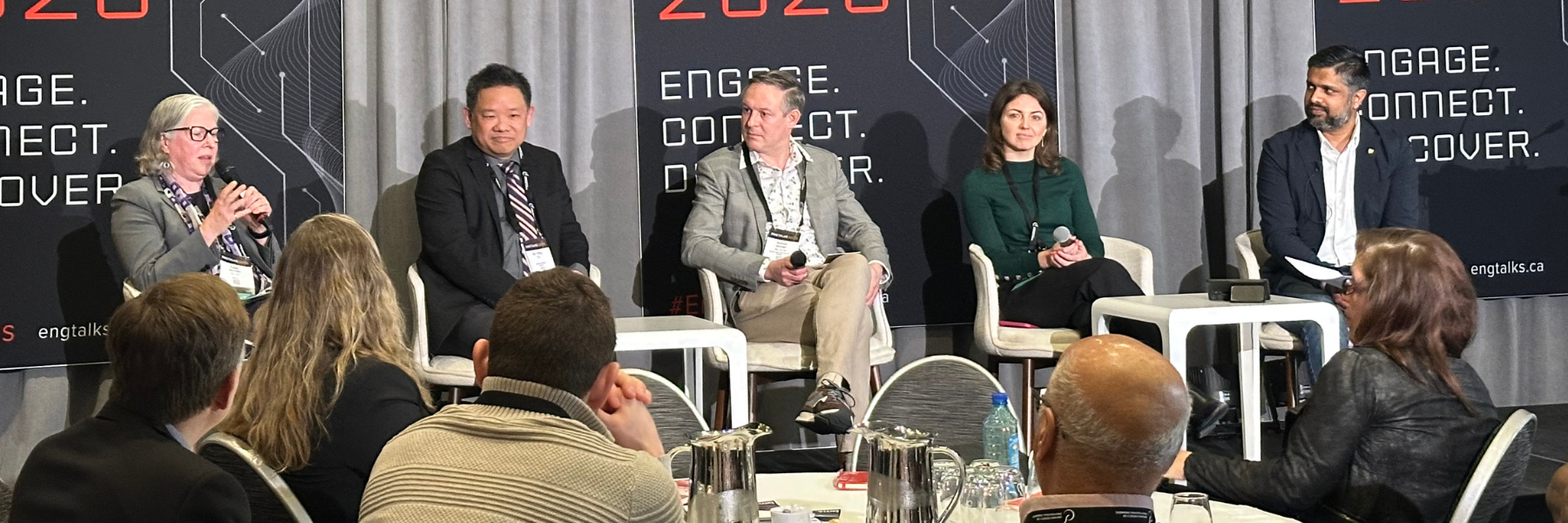
At the recent Ontario Society of Professional Engineers (OSPE) EngTalks event in Waterloo, leaders from across industry and academia came together to explore how AI is reshaping engineering practice—from design and testing to project delivery—and what this means for the future of the profession.
The discussion highlighted a clear shift: engineering is entering a new era defined not only by technological advancement, but by the need for trust, accountability, and new skillsets.
Engineering in an age of acceleration
Across sessions, one theme was consistent: the pace of change is accelerating, and organizations must adapt quickly.
AI is already delivering value in areas such as simulation, optimization, and workflow automation. However, speakers emphasized that adoption is uneven, and that many organizations are still navigating where and how AI can be most effectively applied.
This gap presents both an opportunity and a risk. Those who move quickly and thoughtfully will gain competitive advantage; those who lag may struggle to keep pace.
Trust, accountability, and responsible AI
As AI becomes more embedded in engineering workflows, the importance of trust cannot be overstated.
Sessions explored how engineers and organizations must ensure that AI-enabled systems are:
- Transparent in how decisions are made
- Accountable in their outcomes
- Equitable in their impact
Establishing standards, frameworks, and governance models will be critical to ensuring that AI enhances, rather than undermines, confidence in engineering work.
This represents a fundamental shift in responsibility: engineers are no longer only designing systems, but also shaping how intelligent systems behave.
The talent imperative
The transformation of engineering is ultimately a talent challenge.
Dr. Mary Wells, dean of engineering at the University of Waterloo, opened the day by emphasizing the importance of preparing future-ready talent—professionals who can work effectively alongside AI while maintaining critical thinking, ethical judgment, and domain expertise.
This shift is not limited to new graduates. It requires ongoing upskilling for experienced professionals, as roles evolve and new capabilities become essential.
Engineering organizations must now prioritize continuous learning as a core strategic function.
Engineering's role in global challenges
AI is also expanding the scope of what engineering can address.
In a session on net-zero transformation, Dr. Richard Florizone highlighted the role of innovation—and AI in particular—in tackling complex global challenges. From climate change to infrastructure resilience, engineering is increasingly at the forefront of solutions that require both technical expertise and systems-level thinking.
This raises the bar for the profession: engineers must not only adopt new tools, but also apply them responsibly in high-stakes contexts.
From insight to action
WatSPEED was proud to contribute to this important conversation, with participation from associate vice-president, innovation Sanjeev Gill, and executive director Aaron Pereira.
In his remarks, Gill spoke to the pace at which AI is advancing and the growing gap between technical change and workforce readiness, highlighting the need for organizations to build the capabilities required to keep pace with this shift.
Pereira moderated a panel exploring where AI is delivering value today—from established approaches like machine learning to emerging generative tools—discussing where it is delivering real value and where important gaps remain.
Events like OSPE’s EngTalks reinforce a critical reality: advancing engineering in the age of AI requires collaboration across academia, industry, and professional communities.
For WatSPEED, this underscores the importance of equipping professionals with the skills, frameworks, and perspectives needed to lead in this evolving landscape.
Looking ahead
The future of engineering will be shaped not just by what AI can do, but by how thoughtfully it is applied.
Organizations that invest in talent, embrace responsible innovation, and engage in cross-sector collaboration will be best positioned to lead.
As the conversation continues, one thing is clear: the integration of AI into engineering is not optional. It is foundational to the next chapter of the profession.