Only a few years ago, executive conversations about artificial intelligence (AI) focused largely on automation, productivity, and experimentation. Today, leaders are asking much bigger questions.
How will AI reshape global competition? What does it mean for Canada's competitiveness? Who controls the infrastructure that powers AI? And how should organizations prepare as technology evolves faster than the policies designed to govern it?
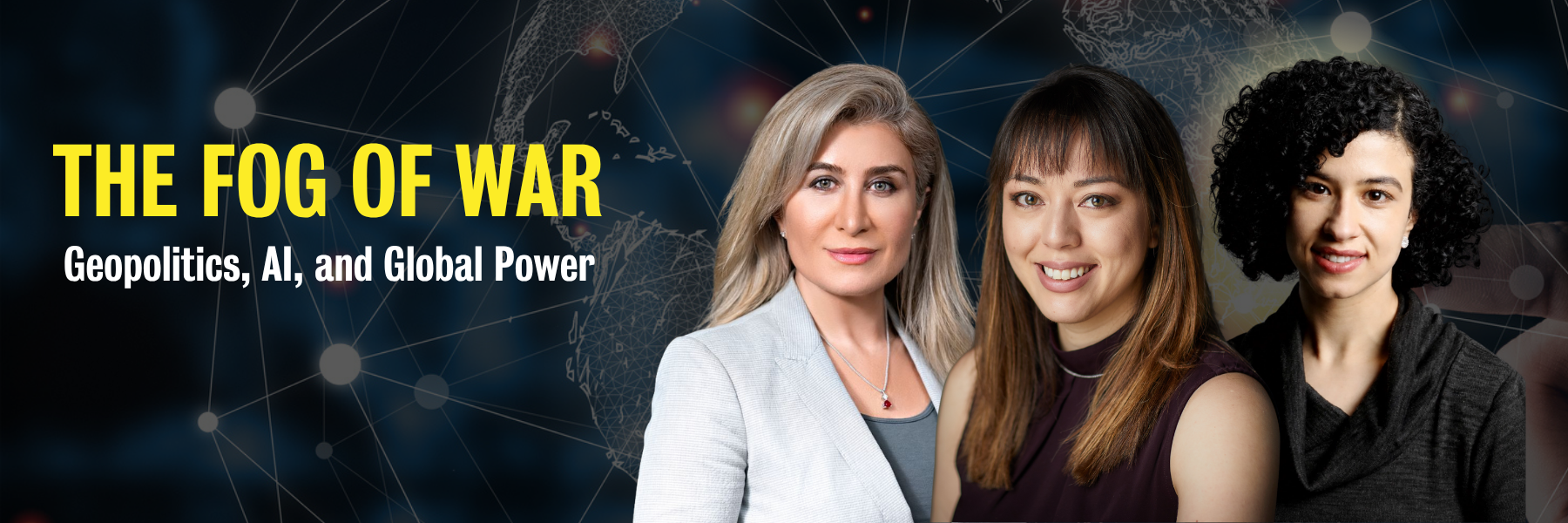
These questions were the focus of The Fog of War: Geopolitics, AI, and Global Power, a recent WatSPEED webinar featuring internationally recognized experts Dr. Bessma Momani (University of Waterloo), Dr. Samantha Bradshaw (American University), and Dr. Sarah Shoker (University of California, Berkeley).
More than 750 professionals from government, industry, higher education, health care, financial services, and the nonprofit sector registered for the session, underscoring the growing demand for informed conversations about AI's broader implications for organizations, governments, and society.
Together, the discussion revealed three strategic shifts every leader must understand,
offering a practical framework for thinking about AI beyond the headlines.
AI strategy is becoming geopolitical strategy
Opening the discussion, Dr. Bessma Momani encouraged leaders to rethink how they approach AI. Rather than viewing AI solely as a technology issue, she challenged participants to consider its growing influence on geopolitics, economic competitiveness, national security, and global power.
"The interdependency of this model, of the AI stack, is unravelling before our eyes," says Momani, Professor, Political Science at Waterloo.
As AI becomes increasingly interconnected with global supply chains, critical resources,
and international competition, understanding the technology also means understanding
the geopolitical systems shaping its future.
AI is advancing faster than governance
Across defence, security, and public policy, AI is already influencing decision-making while governments and international institutions work to establish governance frameworks.
"We're seeing these technologies deployed before we've had the opportunity to establish the governance structures around them," says Dr. Sarah Shoker, Senior Research Scholar at UC Berkeley’s Risk and Security Lab. "It's hard to think of how it's not geopolitical."
Drawing on examples from Ukraine and other global conflicts, Shoker shared why organizations
can no longer wait for governance to mature before considering AI's strategic, ethical,
and operational implications.
The AI race is also an infrastructure race
While much of the public conversation focuses on AI models themselves, Dr. Samantha Bradshaw challenged leaders to think about the broader systems that make AI possible.
"I don't think we should talk about AI as just one thing, because it is a stack, and at every layer of the technology, geopolitics intersects with it," says Bradshaw, Director of the Centre for Security, Innovation, and New Technology at American University. "Tech policy now is everything policy. It reaches into trade policy, energy policy, industrial policy, labour policy, education policy... it reaches into every sector."
From semiconductors and critical minerals to energy, computing infrastructure, and
global supply chains, the discussion reinforced that AI strategy is increasingly inseparable
from industrial policy, infrastructure, and long-term organizational resilience.
The leadership challenge
Although each speaker approached AI from a different perspective, one message remained remarkably consistent: organizations are no longer navigating technology in isolation.
That reality was also reflected in the questions attendees brought to the discussion. Leaders wanted to understand Canada's role in the global AI race, governance frameworks, national security, AI sovereignty, supply chains, and organizational resilience.
Together, these questions reveal a broader shift in executive thinking. AI is no longer
simply a technology to adopt — it is becoming a strategic issue that touches competitiveness,
governance, public policy, and long-term organizational success.
Continue the conversation
Understanding AI today requires more than following technology trends. It requires understanding the geopolitical, economic, and governance forces shaping how AI is developed, deployed, and regulated around the world.
Whether you're responsible for strategy, innovation, digital transformation, public
policy, risk, or organizational leadership, The Fog of War: Geopolitics, AI, and Global Power offers a deeper exploration of these issues through the perspectives of internationally
recognized experts in political science, technology policy, and AI governance.